Reduce stockouts. Cut excess inventory.
Turn your order history into a live forecast, buy list and reorder points inside the inventory system your team already uses. We build it for you and review the first cycle with your buyer.
- First findings inside a week
- No platform replacement
- 30% fewer stockouts in 90 days, or we keep working
Free. No obligation. You keep the findings.
Book a call first. We’ll confirm your setup and arrange the diagnosis.
 81 → 0 stockouts on committed ordersDiagnosis vs since go-live · 100% reductionRMA Sport, online + B2B · See the client result



Any business losing sales to stockouts or cash to excess inventory
If you buy stock ahead of demand and someone rebuilds the reorder maths every week, you are already paying for this twice: once in stockouts, once in stock that doesn't move.
If you have never lost a sale to a stockout or written off stock you overbought, you don't need us yet.
- Revenue
- $1M+
- You are
- Ecommerce, wholesale, distribution, manufacturing, trades with a warehouse. Anyone who buys stock ahead of demand
- Stock
- In a warehouse, a store, vans, or all three
- Systems
- Any store, inventory app or ERP, any accounting package. We build inside what you already run
- Symptom
- Reordering decided in a spreadsheet or from memory
Two ways to lose money on the same shelf
Stockouts
You find out from a customer. The order was already committed, the supplier is eight weeks out, and the sale goes to someone else.
Excess inventory
Cash sits on the shelf in the wrong SKUs. A supplier invoice lands and the money is in the warehouse, not the bank.
The spreadsheet in the middle
Order too little, stockout. Order too much, excess. Lead times measured in months turn every guess into a bet on the season.
AI-powered demand planning that turns forecasts into buying decisions
We don't sell you another app. Your order history, stock and supplier lead times already live in your systems. We turn them into a forecast, then into buying decisions, in the place your team already works.
AI-powered forecasting
24 months of your orders, seasonality and lead time, per SKU. Rebuilt nightly from real sales, not last year's spreadsheet.
AI-powered replenishment
Reorder points, buy-by dates and purchase order recommendations with minimum order quantities built in. The January order is bought in August, not found short in December.
AI inventory allocation
Wholesale commitments protected, online store stops at what's available, so a big DTC weekend never eats a wholesale order.
Weeks of cover.
The number that changes buying decisions.
Available stock divided by real rate of sale, per SKU, with incoming stock and lead time. Under four weeks of cover with an eight-week supplier is a stockout you can still stop. Forty weeks of cover is cash you can stop tying up.
Explore the working demo Illustrative data. Your live data comes in during diagnosis.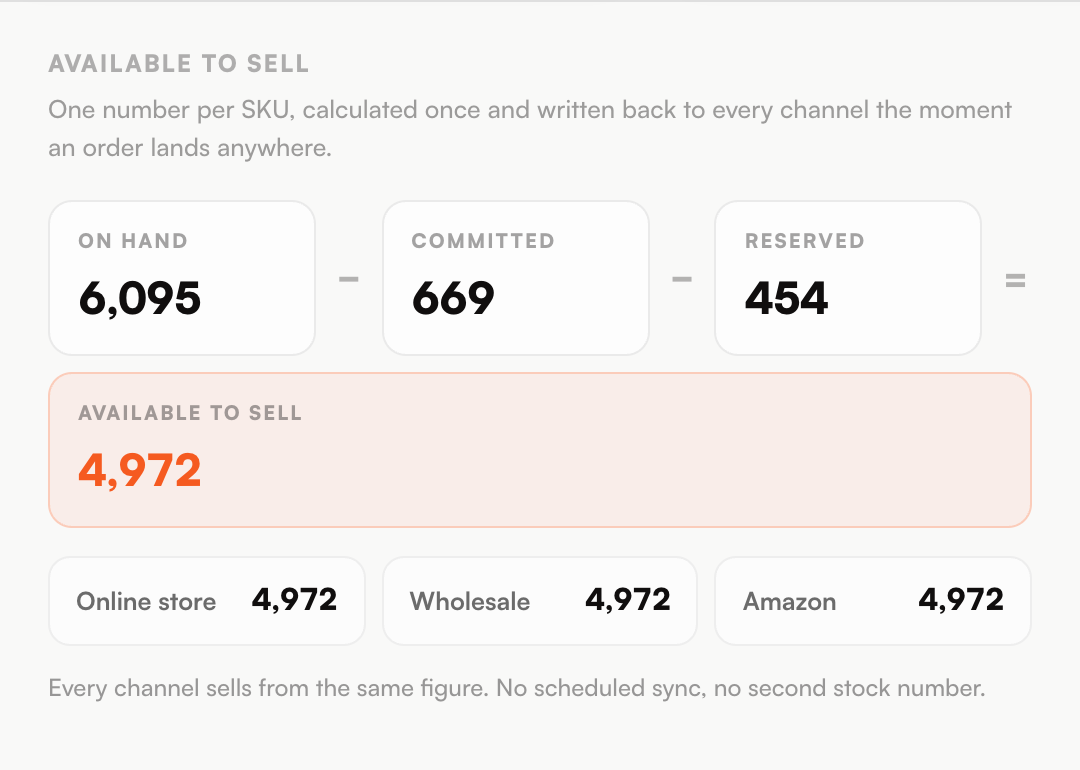
The number itself, from the live demo. Build yours in two minutes →
What each role sees
My priorities
Each role starts the day with its three or four real priorities: what to count, what to chase, what to fix.
Stock position
What you can actually sell right now: on hand minus what open orders already committed, across every location.
Order risk
Every open order checked line by line against available stock, so a promise at risk surfaces before the date slips.
Forecast and buy list
Weeks of cover, seasonality, next quarter projected and dead stock, built from your own order history.
Plugs into what you already run
 ShopifyShopify PlusShopifyShopify Plus
See your stockouts and excess inventory in two minutes
No call, no signup. Answer five questions and the demo builds a working dashboard around your brand in your browser, then walks you through it.
- 1Drop in your website. It reads your site and pre-fills the rest.
- 2Confirm five answers. Category, platform, SKUs, unit cost.
- 3Walk the dashboard. Weeks of cover, SKUs heading for stockout, dead stock and next quarter's demand, built around your answers.
Two minutes. Illustrative data, generated in your browser.
What changed when demand planning went live
Real results from EZYE implementations. Figures from client systems and engagement records.
Find out where stock is costing your business.
Get my free stock diagnosisYour last 90 days. Clear findings. Yours to keep.You pay for a result, not a promise.
Down 30%, or we keep working
Stockouts on committed orders down at least 30% within 90 days of go-live, measured against your last-90-day baseline, or we keep working free until they are.
You own it
Every connection, every forecast, every rule runs on your accounts. Cancel us and keep all of it.
Written into every engagement.
Three steps, then it's yours
AI analysis of your data
24 months of orders, stock on hand, open orders and supplier lead times, read from the systems you already run. Out of it comes your baseline: every stockout on a committed order and every dollar of excess inventory at cost, per SKU.
AI-powered forecasting, replenishment and allocation
A forecast per SKU, then reorder points, buy-by dates and purchase order recommendations with lead times and minimum order quantities built in, plus allocation rules per channel. Built inside your inventory system. Live within 30 days.
We run the first cycle with you
Weekly replenishment review with your buyer for 90 days, forecast accuracy tracked against real sales, your team trained on their own view. Then handover.
Straight answers
Will this actually reduce stockouts, or just forecast them?
What if stockouts don't come down by 30%?
How is this different from Inventory Planner, Prediko or Cogsy?
What does the free diagnosis actually cover?
What do you connect to?
Do we have to change how we work?
How long until it's live?
Who is this for?
Who owns what you build?
See exactly where stockouts and excess inventory cost you last quarter.
We review your last 90 days of orders and stock across your channels. You get a clear picture of:
- Stockouts on committed orders
Orders promised against stock that wasn’t there.
- Excess inventory
Units that haven’t moved, priced at cost.
- Heading for stockout
SKUs under four weeks of cover against supplier lead time.
What happens next: book a call, confirm your setup, then arrange read access.
The diagnosis takes one hour of your time, with first findings inside a week. No obligation.